Displaced to Learn: How DCPS Swing Spaces Reshape Access, Attendance, and Equity
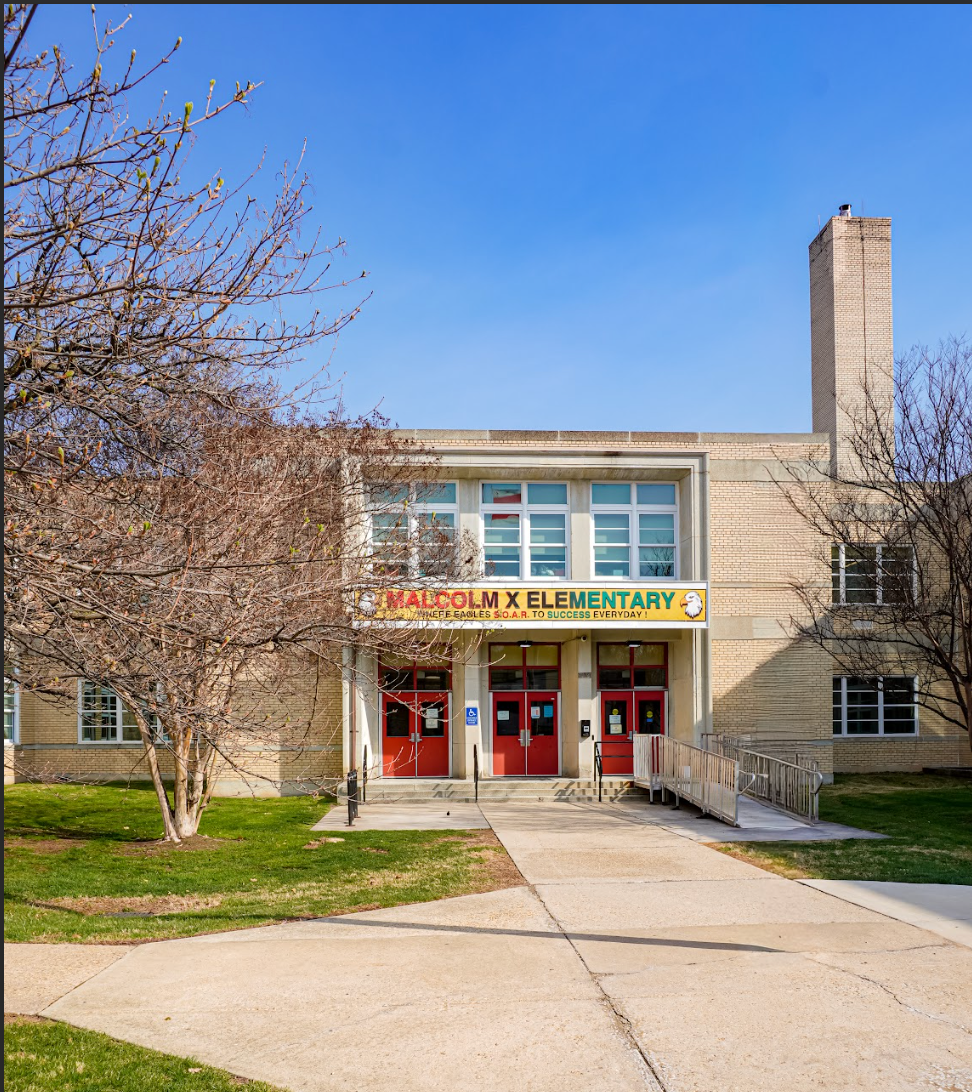
Malcolm X Elementary School
Photographed By Isaiah Cole
Written By: Shanchara Marius and Tamara Bell
DC Public Schools (DCPS) school modernization projects are implemented through a partnership with the Department of General Services (DGS), where DGS manages construction and DCPS leads communication with school communities. While modernization is essential for improving aging facilities, the use of “swing spaces” (temporary school locations during construction) introduces a set of consistent challenges that extend beyond logistics. Early findings suggest that distance, transportation access, and relocation conditions significantly affect student attendance, family engagement, and overall school stability (District of Columbia Public Schools [DCPS], n.d.).
Across modernization projects, several patterns emerge. First, the distance between schools and their swing spaces varies widely, ranging from under one mile to nearly four miles. Second, transportation support is inconsistent. Some schools receive structured bus service, while others rely on families to adjust independently using walking routes or public transit. Third, relocation often disrupts school culture and operations, particularly when students are displaced outside their immediate neighborhood or when the temporary facility presents new logistical or environmental challenges (DCPS, 2025; 51st News, 2024).
A key example is Malcolm X Elementary School, which relocated from 1500 Mississippi Avenue SE to the Davis School at 4430 H Street SE during modernization. This move effectively displaced students from Ward 8 into Ward 7, requiring coordinated bus transportation between the original site and the swing space (DCPS, n.d.). While transportation was provided, the relocation still introduced additional commute time and reduced proximity to families’ homes. This type of cross-neighborhood displacement can make consistent attendance and family participation more difficult, particularly for working families managing multiple responsibilities.
In contrast, J.O. Wilson Elementary School experienced a shorter relocation from 660 K Street NE to 810 26th Street NE, less than two miles away. Despite the relatively short distance, the school still required daily bus transportation to maintain accessibility for students and families (J.O. Wilson Elementary School, n.d.). This suggests that even modest increases in distance can create barriers significant enough to require institutional support.
Tubman Elementary School provides insight into the impacts of a “nearby” relocation without transportation support. Tubman moved approximately 0.7 miles to the Old Banneker building. While this distance may appear manageable, families reported an additional 12–15 minutes added to their daily commute. Some students transferred schools, and the campus lost access to a key aftercare provider due to the relocation. This highlights how even small geographic shifts can disrupt established routines, support systems, and enrollment stability when transportation is not provided (Team Tubman, n.d.; 51st News, 2024).
Similarly, Thomas Elementary School utilized the Kenilworth swing space during modernization. Although both locations are within Ward 7, DCPS still implemented transportation services to ensure safe and consistent student access. This reinforces the idea that proximity alone does not eliminate transportation needs; rather, accessibility must be evaluated in terms of safety, time, and family capacity (DCPS, n.d.).
Looking across additional examples, the scale of disruption becomes even clearer. Community testimony around Brent Elementary School described a relocation distance of approximately 3.7 miles—one of the longest in DCPS modernization efforts. At that scale, walking or independent commuting becomes impractical for most families. Similarly, Truesdell Elementary School experienced a significant enrollment decline during its swing-space period, dropping from approximately 460 to 375 students (DCPS, 2025). This pattern suggests that relocation can directly influence whether families choose to remain enrolled.
Taken together, these examples point to a consistent conclusion: swing space is not simply a facilities issue, it is an educational equity issue. Increased travel time, unfamiliar routes, and reduced proximity to school communities can contribute to chronic absenteeism, decreased family engagement, and enrollment instability. Additionally, disruptions to aftercare programs, staffing consistency, and daily routines can alter the overall culture of a school during the modernization period (51st News, 2024; DCPS, 2025).
From a policy and planning perspective, these findings suggest several priorities. First, swing spaces should be selected with a strong emphasis on geographic proximity to the original school community whenever possible. Second, transportation support should be proactively provided whenever relocation meaningfully alters travel time, regardless of strict distance thresholds. Third, schools undergoing modernization should receive targeted support to stabilize enrollment, maintain programming, and preserve community engagement during the transition period.
Ultimately, while modernization investments are critical for long-term student outcomes, the short-term impacts of swing space must be more intentionally addressed. Without deliberate planning around distance, transportation, and continuity of services, the modernization process risks creating temporary but significant barriers for the very students and families it is intended to support.
References
51st News. (2024). Harriet Tubman Elementary School budget cuts and modernization impacts.
https://51st.news/harriet-tubman-elementary-school-budget-cuts/
District of Columbia Public Schools. (n.d.). Upcoming changes to school locations and programs.
https://dcps.dc.gov/page/upcoming-changes-school-locations-and-programs
District of Columbia Public Schools. (2025). FY26 budget hearing written testimony.
https://dcps.dc.gov/sites/default/files/dc/sites/dcps/page_content/attachments/FY26%20Budget%
20Hearing%20Written%20Testimony.pdf
District of Columbia Public Schools. (n.d.). DCPS facilities and swing spaces overview.
https://sites.google.com/dc.gov/dcps-facilities/swing-spaces
J.O. Wilson Elementary School. (n.d.). Modernization information.
https://www.jowilsondcps.org/about/modernization
Team Tubman. (n.d.). Our move: Tubman Elementary relocation details.